MORNING MOON STUDIO
MORNING MOON STUDIO
BookstoreNewsletterAboutMethodPrivate StudioYear-End Special

‹ Back

The sorrows of the world for breakfast and why Herr Goethe had enough

Newsletter · November 2026 · News anxiety

Free with this issue: the first of five boundaries from The Shield ↓

“Our morning newspaper, that we read with our breakfast, has the history of the sorrows of the whole world for a day.”

The New York physician George Beard wrote that in 1881, in a book called American Nervousness. He meant it as a warning: the morning paper, he argued, robs anyone who feels for others “of more or less nervous strength.”
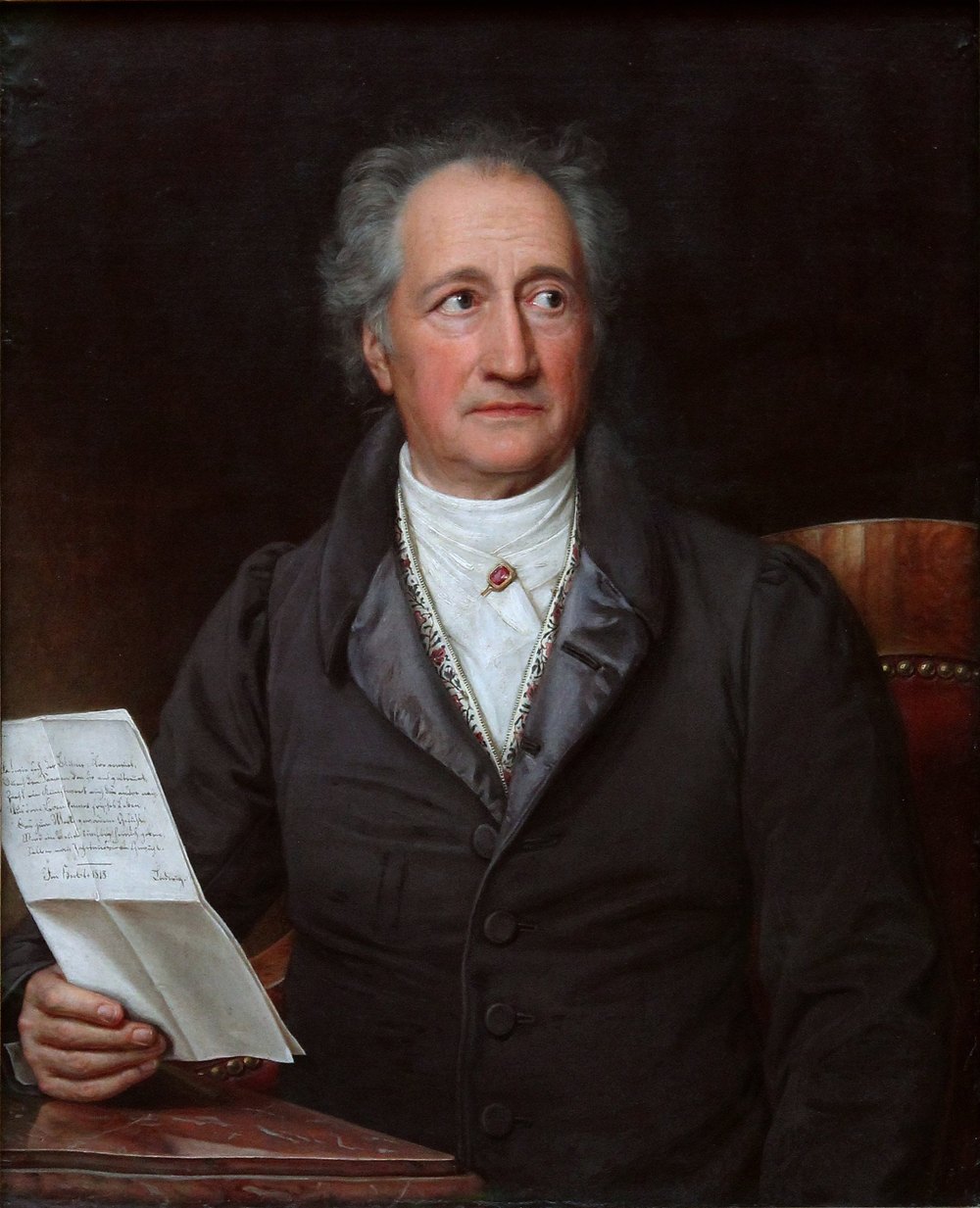
Portrait of Johann Wolfgang von Goethe at 79, holding a letter, by Joseph Karl Stieler
Goethe at 79, by Joseph Karl Stieler, 1828 · Neue Pinakothek, Munich, public domain.

He was not the only one who noticed. In March 1830, Goethe was eighty and deep in the second part of Faust. He left his two Paris newspapers unopened for about two weeks and asked his friends to tell him the news instead. His work, he said, was coming along quite nicely. In 1854, Thoreau wrote from his cabin at Walden Pond: “If we read of one man robbed, or murdered, or killed by accident … we never need read of another. One is enough.”

“I must hold it for the greatest calamity of our time … that one moment is consumed by the next. Have we not already newspapers for every hour of the day!”Goethe, Maxims and Reflections, translated by T. Bailey Saunders, 1906

A poet, a philosopher and a doctor, all three early cases of news anxiety. Their news might have been just as distressing and disturbing as ours, but they had a few pages of small print, no photographs yet, read once a day or even once a week. When they folded the paper and got up, the news stayed on the table.

It’s nothing compared to what we are living through. The paper is now a phone: an endless flow of uninvited, uncontrolled images, updates and opinions, amplified by social media feeds that exploit our emotional triggers for engagement. Whatever upsets us or makes us angry gets more clicks and shares, so that is what we see more of.

We are the first generations to live like this. We never decided to. We slid into it, one more app, one more preset alert, one more scroll at a time, with no precedent, no one to warn us and no blueprint to protect us. But we are beginning to feel strongly what this does to us, and what we are losing or have already lost. Across much of the world, the young have started to pull back: time spent on social media has been falling since 2022, most of all among teens and twenty-somethings, though not yet in North America.
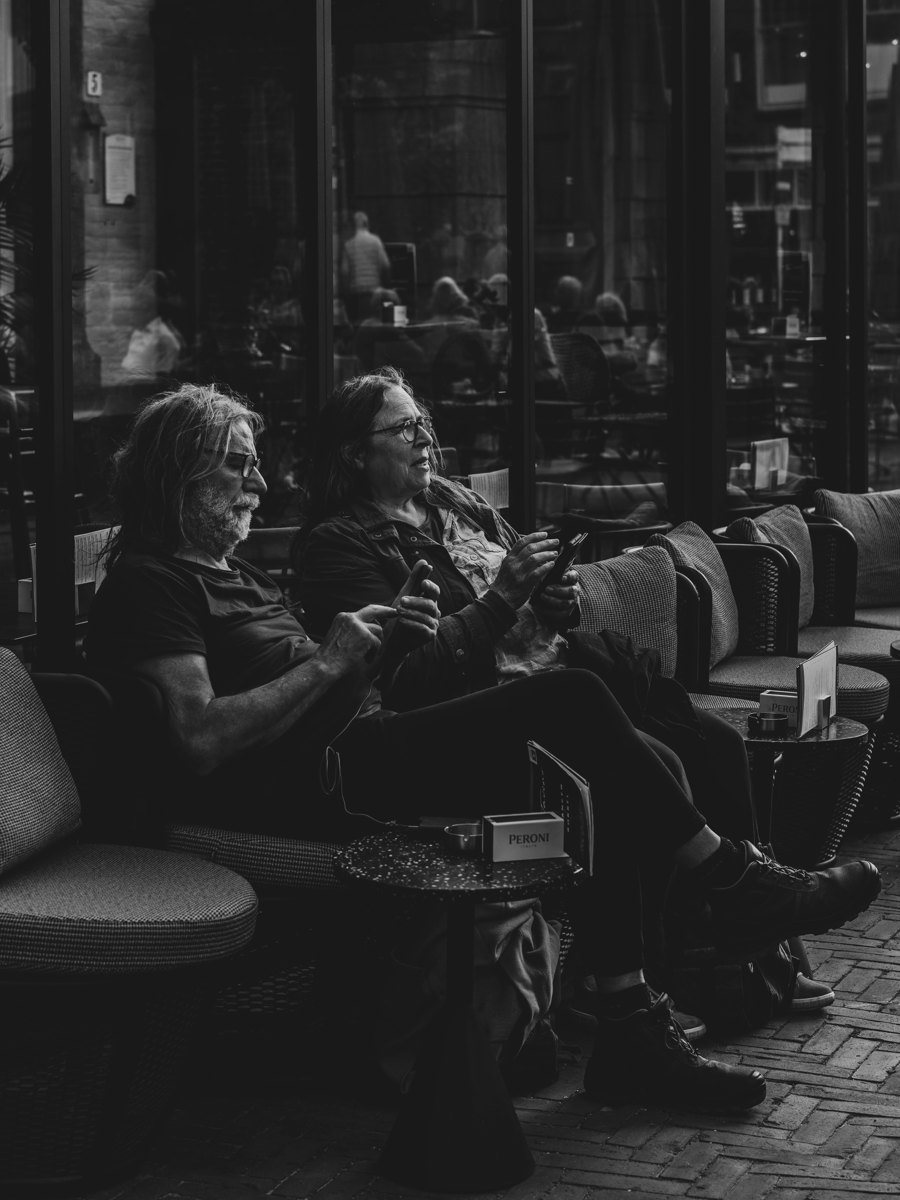
An older couple on a café bench, each looking at a phone, in black and white
Counting television, people of retirement age now spend more time in front of screens than young adults, and their time online keeps growing. · Photo: Haberdoedas on Unsplash

The solution is obvious and seems doable. Let’s all just put the phone down and walk away. Problem solved. As obvious as it might seem, it is far from easy. Other forces are in power, and they take control before we have decided anything. Some sit outside us: apps built to keep us scrolling and coming back. Others sit inside us, and they are much older than any phone.

But here is the good news: we now know much of what keeps us reaching for the phone, and we can work on each part of it.

The news is not going to get quieter, so this may be the right time to step back, look at what it does to us, and decide how much of our life we are willing to give it.

Goethe kept up with the world through his friends, and he finished Faust the following summer. What we are up against is much stronger than what he faced, but we can learn how it works and regain some power over it, one part at a time.

This issue’s free gift is the first of the five boundaries from The Shield: decide what news reaches you, and when, with checklists to close the ways it gets in. Leave your email and it comes to you right away, along with the next issues.

The Shield, Field Notes №01, protects you on every level the news reaches: your attention, your thoughts and your feelings. There is a difference between being informed and being consumed.
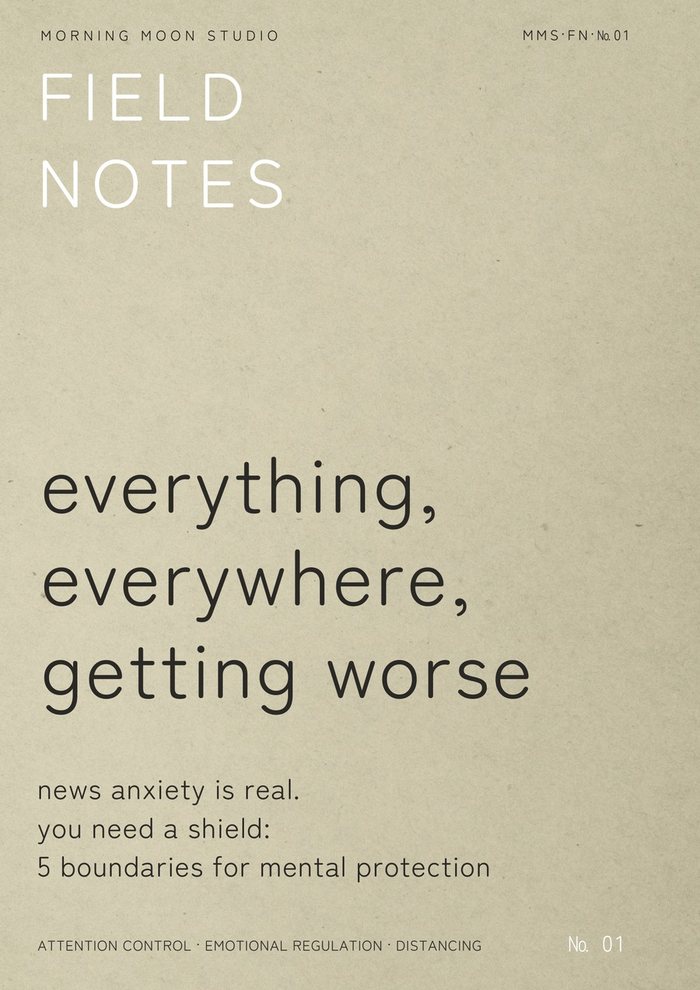
Cover of everything, everywhere, getting worse
Field Notes №01 · Morning Moon Studio
View the title →

Three things to try

  1. 01

    Give the news a time. Decide when you will catch up and for how long, for example twenty minutes after lunch, and set a timer. When it goes off, close the source and tell yourself: “I have checked what I need to know. The rest can wait until my next news time.” People who received their notifications in three batches a day felt less stressed and more in control than people who got them as usual.

  2. 02

    Wait two minutes. When the urge to check appears, notice it first: where you feel it, how strong it is, how it rises and falls. Then wait two minutes before you open anything, and spend them on something you enjoy: a song, two pages of a book, a look out of the window. If you still want to check after two minutes, go ahead.

  3. 03

    Ask what is yours to do. When a story keeps coming back, ask whether there is anything useful you can do right now. If there is, do it, or decide when you will. If there is not, tell yourself: “This matters, but there is nothing more for me to do right now.”

Know someone who needs this? Forward it to them. If it was forwarded to you, you can subscribe at morningmoonstudio.com.

Sources: Johann Wolfgang von Goethe, Maxims and Reflections, translated by T. Bailey Saunders (1906) · George M. Beard, American Nervousness (1881) · Henry D. Thoreau, Walden (1854) · Johann Peter Eckermann, Gespräche mit Goethe, entry of 6 March 1830 · Claire E. Robertson and colleagues (2023) · William J. Brady and colleagues (2017) · Smitha Milli and colleagues (2025) · John Burn-Murdoch, “Have we passed peak social media?”, Financial Times (2025) · “Meet the real screen addicts: the elderly”, The Economist (2025) · Nicholas Fitz and colleagues (2019) · Sarah Bowen and G. Alan Marlatt (2009)
Haunted by the Hunchback of Notre-Dame

Newsletter · October 2026 · Procrastination

Free with this issue: Decision Clearing, a method for the decisions you keep putting off ↓

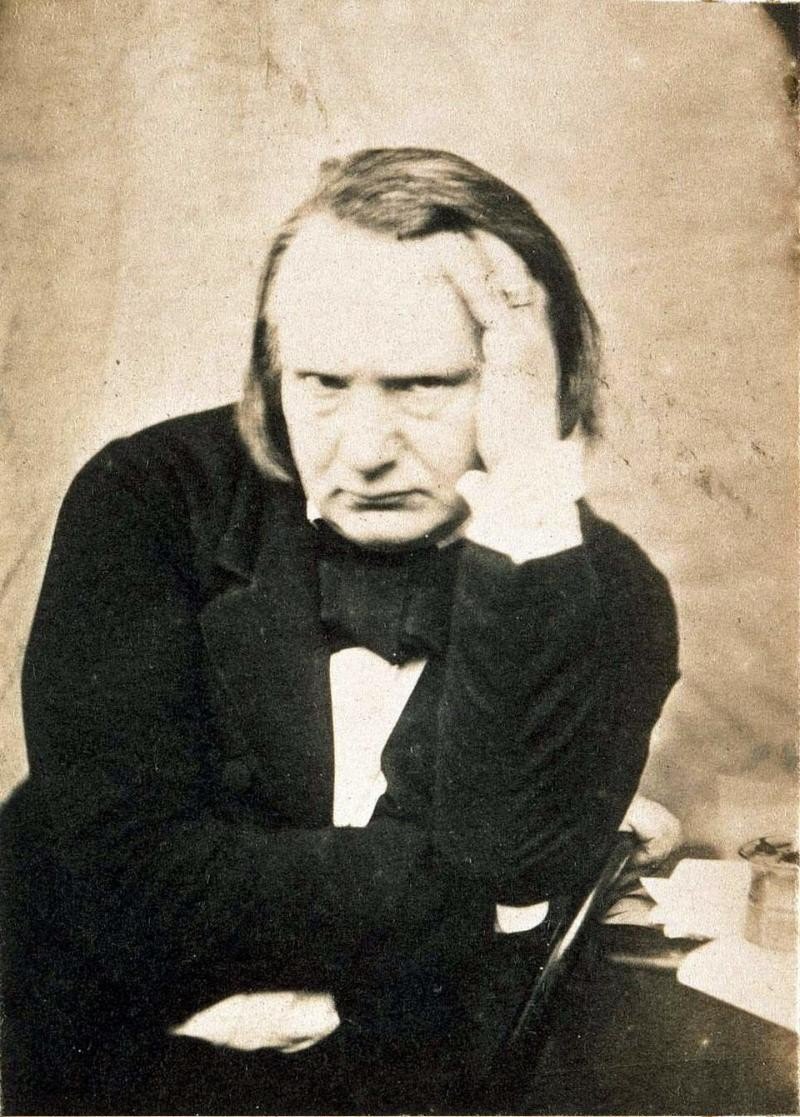
Victor Hugo, photographed around 1853
Victor Hugo, c. 1853 · Wikimedia Commons, public domain

In 1830, Victor Hugo was so far behind on a novel he had promised his publisher that he was given a final deadline: February 1831. The story goes that he locked away his clothes so he could not go out, and wrote. The book was The Hunchback of Notre-Dame.

So, that’s one strategy to get things done. But the question is: why is it so hard to simply do what we need to do? Why do we put ourselves through weeks of dread, a small jolt every time the task comes to mind, instead of spending the few minutes it takes?

There is no single answer. Several forces work on us at once: how our lives have changed, how we escape what feels bad, and how our brain holds on to unfinished things. Take the first: we often have no visible proof that our tasks are over.

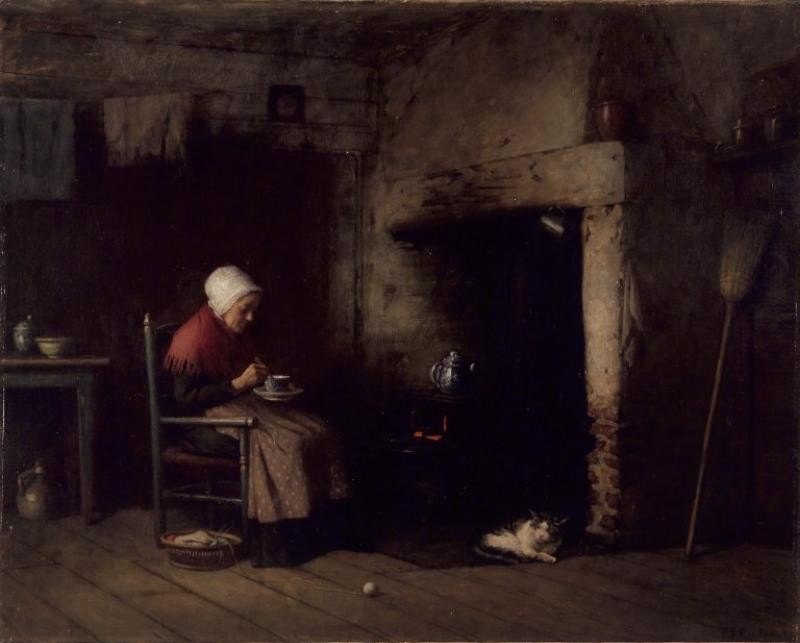
Platt Powell Ryder, Fireside Companion: a woman resting by the fire with a cup of tea
Platt Powell Ryder, Fireside Companion, c. 1889 · Brooklyn Museum, public domain

Before machines took over much of the housework, washing alone could take a whole day: water heated by the bucket, every sheet scrubbed, wrung and hung by hand. It was hard, physical work, but its progress was visible. The pile of laundry in the morning was a line of clean sheets by evening. The task was over, and an evening hour in front of the fireplace came with a sense of accomplishment and room for recovery.

Today, machines do most of that labor, and our load looks lighter. But we have acquired a different kind of work, less visible and harder to leave behind when the day is over: an email to answer, a password to reset, a form to upload, a payment to check, a contract to decide on.

And then there is the task itself. An unpleasant task means facing uncertainty, disappointing someone or finding out something we would rather not know. If we put it off, we feel relief right away, while the benefit of doing it lies further ahead. Under strain, that relief becomes especially tempting.

Even when we stop, the unfinished things stay with us. Why should an email we have not answered occupy part of an evening when we are nowhere near our desk?

One of the first clues came from the psychologist Bluma Zeigarnik, and it began with her teacher, Kurt Lewin, in a restaurant in Berlin in the 1920s. The story is that Lewin noticed something about the waiter. As long as a table had not paid, the waiter knew exactly what everyone had ordered. Once the bill was paid, the details were gone.

Zeigarnik wanted to know whether we all work that way. She gave people small tasks, let them finish some and stopped them in the middle of others. Later, they remembered more of the unfinished ones.

Researchers have argued since then about how reliably this effect appears. But in 2011, two psychologists, E. J. Masicampo and Roy Baumeister, found something useful: making a concrete plan reduced the thoughts about unfinished goals that interrupted people while they did something else. They did not have to finish the work first. They had to decide what they would do, when and where.

That is what a plan can do. It gives the task a place, the way washday once had its Monday, so it takes less room in our heads. That room is what we need back: for thinking, for the people around us, for the late dinner, the unplanned trip, the night that runs on too long, all the things that become memories.

Hugo met his deadline, and the book is still read almost two hundred years later. Most of us are not writing a novel, and none of us should have to lock away our clothes to get through a to-do list. What helps is a place for each task, a way through the hard ones, and a little less blame.

This issue’s free gift is Decision Clearing, a method for the decisions you keep putting off.

Download · US LetterDownload · A4

A plan gives a task a place, but it does not take away the dread. That is why the task management system in Field Notes №03 works on the emotional barriers too: fear of the answer, worry about disappointing someone, plain dislike. Each one gets its own way through.

Cover of It’s Brain vs To-Do List
Field Notes №03 · Morning Moon Studio
View the title →

Three things to try

  1. 01

    Forgive yourself for procrastinating. When you notice you have put something off again, admit it, drop the self-reproach, and go on to the next step. Students who forgave themselves for delaying their exam preparation tended to procrastinate less before their next exam.

  2. 02

    Decide when and where. Take the task that has been waiting since spring and write down the day, the time and the place you will do it. In an exercise study, 91% of students given motivational information plus a specific plan exercised the following week, compared with 35% given motivational information alone.

  3. 03

    Write tomorrow’s tasks down before bed. In a small laboratory study, people who did this for five minutes fell asleep about nine minutes sooner than those who wrote about completed tasks.

Know someone who needs this? Forward it to them. If it was forwarded to you, you can subscribe at morningmoonstudio.com.

Sources: Craig Lambert, Shadow Work (2015) · Bluma Zeigarnik (1927) · E. J. Masicampo and Roy F. Baumeister (2011) · Michael J. A. Wohl, Timothy A. Pychyl and Shannon H. Bennett (2010) · Sarah Milne, Sheina Orbell and Paschal Sheeran (2002) · Michael K. Scullin and colleagues (2018)